The Greekish Life
Culture
Get To Know a Goddess
Hestia - (Εστία)
Goddess of Hearth and Home

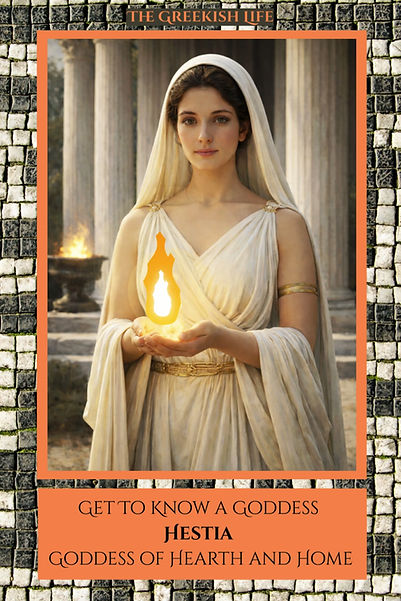
This image was done by me using
ChatGPT, Photoshop and Canva.
If you were ranking the Greek gods by dramatic flair, Hestia would not be fighting for a top spot. She does not hurl thunderbolts, start wars, or turn mortals into unfortunate flora and fauna. And yet, quietly and steadily, she may be one of the most important deities the ancient Greeks ever worshipped.
Hestia is the goddess of the hearth; of fire, home, domestic life, and the communal heart of the city itself. She was one of the original Twelve Olympians, even if later myth gently moved her aside to make room for the far more unruly yet wildly charismatic Dionysus. That contrast alone tells you a lot about her character.
Goddess of the Hearth, Heart, and Home
Hestia’s name literally means hearth or fireplace. In the ancient world, that was no small thing. Fire was essential to survival. It provided warmth, cooked food, and made ritual sacrifice possible. The hearth was the physical and symbolic center of the household, and by extension, the city itself. When the Romans took on the Greek deities as their own, Hestia was turned into Vesta, and was incredibly important to them, as well.
When Greeks set out to found a new colony, they didn't leave home empty-handed. A portion of Hestia’s sacred fire was carefully carried with them, guarded all the way to its new destination. Once lit in the new settlement, that flame became a living link between the colony and the mother city, a quiet reminder of where they came from and who they still were.
Over time, Hestia became the embodiment of that sacred fire. Every home had a hearth, and every city had a public hearth, usually housed in the prytaneion, the civic heart of the polis. Wherever there was ordered communal life, Hestia was there.
She was honored first and last at every sacrifice. Before the gods feasted, Hestia received her share. When the meal ended, she received the final offering as well. She was quiet, steady, and always present.
In art, Hestia mirrors that same sense of dignity and restraint. She is shown standing, fully draped, never adorned for spectacle. Her face is calm, grave, and composed, the expression of a goddess whose power lies in steadiness rather than display.

Image from Wikimedia Commons
Family Ties and an Unusual Birth Order
Hestia was the first-born child of the Titans Cronus and Rhea. Like her siblings, she was swallowed whole by her father, only to be rescued later when Zeus forced Cronus to disgorge his children. Because she was swallowed first and released last, Hestia was sometimes described as both the eldest and the youngest of the Olympians.
Her siblings included Demeter, Hera, Hades, Poseidon, and Zeus. Unlike most of them, Hestia stayed well clear of divine drama. During the Titanomachy - the great war between Titans and Olympians - she is notably absent. Ancient sources suggest this was not weakness but choice. Hestia was a peacemaker by nature.
The Vow That Kept the Peace
Hestia was worshipped as a "virgin" goddess, not out of rejection of love but out of devotion to harmony. Both Apollo and Poseidon sought her as their wife. Rather than choosing between them (her nephew and brother, respectively - ew) and risking conflict, Hestia placed her hand on Zeus’ head and swore an eternal vow of chastity. In the Homeric Hymn to Aphrodite, the goddess of sex and love has "no power" over Hestia.
As a reward, Zeus granted her a place of honor at the center of every home and temple. She would preside over all sacrifices and receive the richest portions of offerings. In a crochety pantheon fueled by pettiness and rivalry, this was a powerful act of restraint.
A Donkey Saves the Day
Hestia appears in very few myths, but one stands out for its weirdness. It's brought to us by the Romans, so it's a later myth.
At a drunken rustic feast, the fertility god Priapus (do NOT look him up from a work computer! Seriously.) attempted to assault the sleeping goddess. Before he could succeed, a nearby donkey began braying loudly, waking Hestia and alerting the other gods. Priapus was chased away in disgrace.
From that point on, donkeys were rested and decorated with garlands on Hestia’s feast day. It is a rare myth where a goddess is threatened and immediately protected, not by divine violence, but by noise, interruption, and communal outrage.

This image was donte by me using
ChatGPT and Photoshop.
Hestia and the Sacred Flame of Olympia
Hestia’s connection to fire extended well beyond the household. At Olympia, her sacred hearth played a central role in the ancient Olympic Games. The flame maintained in her sanctuary was considered a symbol of unity, continuity, and shared origin.
Before the Games began, runners lit torches from Hestia’s hearth and carried the flame to various parts of the sanctuary and, symbolically, back to their home cities. This act was not about spectacle. It was about connection. Every athlete and every city was linked to the same sacred source.
The modern Olympic flame ceremony traces its symbolic roots to this ancient tradition, even if today it feels more theatrical than devotional. At its heart, it still echoes Hestia’s role as keeper of a fire meant to unite rather than divide.
Worship Without Temples
Despite her importance, Hestia had very few temples and almost no grand statues. She was rarely depicted in art, usually shown as a modest, veiled woman, sometimes holding flowers or standing beside a fire.
The reason is simple. Hestia did not need temples because she was already present. Every hearth was her altar. Every shared meal was an act of worship.
Her offerings were practical and symbolic. Wine, oil, and portions of sacrificial meat. The pig was sacred to her, since animal fat was used to keep the sacred fire burning.

This image was done by me using
ChatGPT and Photoshop.
It's part of my experimental series showing the gods and goddesses of ancient Greece
done in the style of Byzantine art .
To find lots more in this series, look for them on my Instagram page.
From Hestia to Vesta: Rome’s Eternal Flame
When Greek religion was co-opted into Roman life, Hestia became Vesta. While the goddess herself remained quiet and largely unseen, her Roman cult became one of the most powerful and politically important in the city.
At the heart of Rome stood the Temple of Vesta, where an eternal flame burned as a symbol of the city’s survival. If that flame went out, it was believed Rome itself was in danger.
The fire was tended by the Vestal Virgins, six priestesses chosen as young girls who served for thirty years. They were sworn to chastity and held extraordinary privileges for women in ancient Rome, including legal independence and seats of honor at public events.
Their duties were exacting. Neglecting the sacred flame was considered a grave offense, as it symbolized a failure to protect the state itself. Through Vesta, Hestia’s quiet domestic power expanded into something civic, political, and uniquely Roman.
Not Passive. Purposeful.
Hestia is often misunderstood as minor or passive. In reality, she represented something deeply radical in a mythological world obsessed with dominance and conquest. She chose peace. She chose stability. She chose continuity.
In a pantheon of gods who constantly crossed boundaries, Hestia held the line with dignity and serenity.
Hestia’s Epithets: What the Names Tell Us
Epithets were really important to the ancient Greeks when it came to their gods, because an epithet would show a particular facet of a deity that might have multiple - and sometimes contradictory - sides to their personality. (For example, beautiful, loving Aphrodite was also known as "Aphrodite Areia" - Aphrodite the Warlike, in some quarters, and portrayed in full armor.)
Beloved
Greek: Φίλη (Philē) or Φιλομένη (Philomenē, less common)
This is not a flashy cult title, but a descriptive one found in literary contexts. It reflects affection and closeness rather than authority. Hestia is loved because she is familiar and constant, not because she demands devotion.
Eternal
Greek: Αἰώνια (Aiōnia) or ἀέναος (Aenaos, ever-burning)
These terms emphasize the unceasing nature of her fire. They appear in philosophical and poetic texts rather than formal cult inscriptions, reinforcing the idea of continuity rather than power.
She of the Public Hearth
Greek: Ἑστία Δημοσία (Hestia Dēmosia)
This is one of the clearest and most important epithets. It distinguishes Hestia of the household from Hestia of the city. Dēmosia means public or belonging to the people, underscoring her civic role.
Prytanitis
Greek: Πρυτανῖτις (Prytanitis)
This is a formal cult title tied to the prytaneion, the civic hearth and administrative center of the city-state. As Hestia Prytanitis, she presided over official banquets, state hospitality, and the symbolic unity of the polis.
Boulaia
Greek: Βουλαία (Boulaia)
Derived from βουλή (boulē), meaning council. This epithet links Hestia to civic governance and deliberation, not as a speaker or decision-maker, but as the stabilizing presence within which governance occurs.
Roman Equivalent
When Hestia became Vesta in Roman religion, her epithets followed a similar pattern.
Vesta Publica
This directly parallels Hestia Dēmosia, emphasizing her role as guardian of the Roman state through the eternal flame.
Vesta Aeterna
Meaning eternal Vesta, this title reflects the same concern with continuity and permanence that defined her Greek counterpart.
Why This Matters
What stands out is what Hestia does not have. No epithets of conquest or fear-inducing titles. No myth-heavy honorifics tied to violence or domination.
Her names consistently point to place, continuity, and presence. Home. City. Hearth. Council. Eternity.
In other words, Hestia’s epithets reinforce exactly who she is. The goddess who does not move, because everything else moves around her.
_6.jpg)
This file is licensed under the Creative Commons Attribution 4.0 International license.
Attribution:
Mark Landon / Wikimedia Commons
Here are some of the Homeric Hymns to Hestia...
Homeric Hymn 24, To Hestia, is an invocation of five lines, alluding to her role as an attendant to Apollo:
Hestia, you who tend the holy house of the lord Apollo, the Far-shooter at goodly Pytho, with soft oil dripping ever from your locks, come now into this house, come, having one mind with Zeus the all-wise: draw near, and withal bestow grace upon my song.
Homeric Hymn 29, To Hestia invokes Hestia and Hermes:
Hestia, in the high dwellings of all, both deathless gods and men who walk on earth, you have gained an everlasting abode and highest honor: glorious is your portion and your right. For without you mortals hold no banquet, – where one does not duly pour sweet wine in offering to Hestia both first and last. And you, slayer of Argus (an epithet of Hermes), Son of Zeus and Maia, the messenger of the blessed gods, bearer of the goldenrod, the giver of good, be favorable and help us, you and Hestia, the worshipful and dear. Come and dwell in this glorious house in friendship together; for you two, well knowing the noble actions of men, aid on their wisdom and their strength. Hail, Daughter of Cronos, and you also, Hermes, bearer of the goldenrod! Now I will remember you and another song also.
Bacchylides Ode 14b, For Aristoteles of Larisa:
Golden-throned Hestia (Ἐστία χρυσόθρον᾽), you who increase the great prosperity of the rich Agathocleadae, seated in the midst of city streets near the fragrant river Peneius in the valleys of sheep-nurturing Thessaly. From there Aristoteles came to flourishing Cirrha, and was twice crowned, for the glory of horse-mastering Larisa ... (The rest of the ode is lost)
Hestia Today
In a modern context, Hestia feels almost radical in her quietness. If there were such a thing as a divine advocate for opting out, she would be it. Not in a bitter or disengaged way, but in a deliberate one. Hestia pushes gently back against the constant pull to perform, share, hustle, and broadcast. Her power lives in the unremarkable moments we usually rush past. Making coffee before the house is fully awake. Caretaking with no audience. Choosing, occasionally, not to be reachable.
For Hestia, meaning is not found in spectacle. It is found in repetition, care, and presence. The hearth is not glamorous, but it is essential. In that sense, she reframes the domestic sphere not as something small or limiting, but as a place where real grounding happens. A kind of everyday ritual space, whether we recognize it as such or not.
The ancient hearth itself is circular, a shape that suggests continuity rather than conquest. Life under Hestia’s watch is not a straight line aimed at some distant peak. It moves inward as much as forward, looping back on itself, deepening rather than expanding. The work is not about mastering the world, but about learning your own internal landscape. She stands guard over that inner center, the boundary that defines where you end and the rest of the noise begins.
Even Hestia’s virginity takes on a different meaning when viewed this way. It is less about abstention and more about wholeness. She belongs entirely to herself. She is not unfinished or waiting to be completed by anyone else. In human terms, that translates into a rare kind of self-possession. A sense of being contained, grounded, sovereign and intact. To carry Hestia with you is to understand that home is not always a place on a map. Sometimes it is a state of being - quiet, steady, and profoundly enough.
In a world that rewards noise, speed, and spectacle, Hestia feels quietly subversive. She reminds us that not all power needs to shout. Some of it flickers steadily in the background, keeping everything else alive.
The ancient Greeks understood that without the hearth, there was no home. Without the home, there was no city. And without Hestia, none of it held together.
Not flashy. Not dramatic. Just absolutely essential.
Do you enjoy Greek myths and legends? Check out more of our "Get to Know a God/dess" series, as well as some other goodies, in the Culture section!
Did you like this article?
Please Share it on Facebook and
pin it on Pinterest!
Leave a comment below!